
When you look around UK businesses today, you’ll notice some quietly building their operations year by year, while others chase headlines with fast-mo
When you look around UK businesses today, you’ll notice some quietly building their operations year by year, while others chase headlines with fast-moving launches and bold acquisitions. The pressure to grow can feel relentless, especially when competitors seem to be accelerating ahead. Yet the speed at which you scale isn’t the only factor that determines success. Sometimes, a slower, measured approach can set the foundation for a stronger, more adaptable company. The challenge lies in weighing short-term gains against long-term stability, and in choosing a growth path that matches your team, resources, and market realities.
Defining sustainable growth and rapid expansion
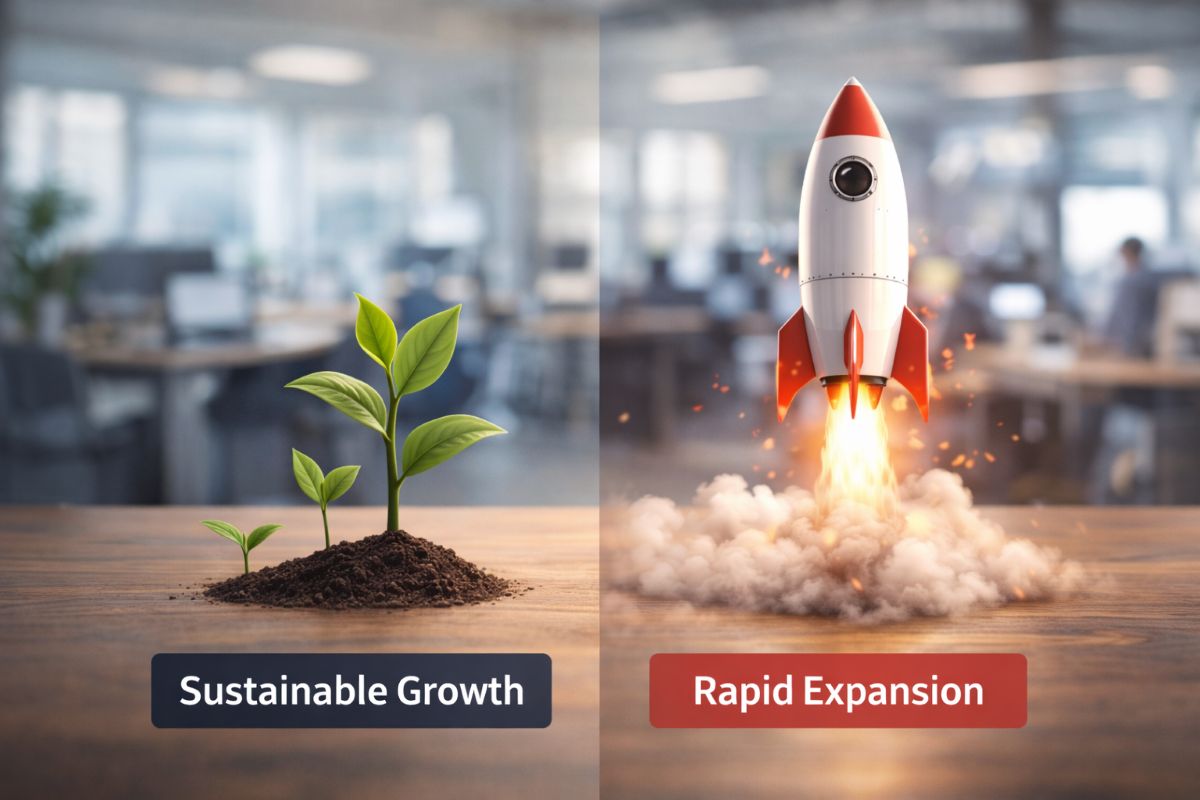
Sustainable growth focuses on steady increases in revenue and profitability. It relies on careful cash flow management and deliberate scaling. For a UK SME, this might mean expanding product lines only after securing consistent sales or opening new locations once existing branches operate smoothly. Access to funding still matters, but businesses largely reinvest profits rather than depending heavily on external capital.
Rapid expansion, by contrast, aims to capture market share quickly. Companies following this path often hire aggressively, secure external funding, and push into new regions in months rather than years. According to UK SME growth statistics, firms with easier access to venture capital or bank loans can accelerate faster, yet they also take on greater risk. The core difference lies in the tolerance for uncertainty: sustainable growth favours measured risk over a longer time horizon, while rapid expansion bets on speed to outpace competitors.
Financial risk, cash flow & operational pressure
Rapid expansion puts intense pressure on cash flow. Hiring at pace can strain your culture and create gaps in leadership. Supply chains may struggle to keep up, and overtrading, a common challenge for UK SMEs, can lead to costly mistakes. Many businesses underestimate how quickly debt levels rise when relying on external funding, whether through loans or private equity.
Sustainable growth mitigates these pressures by allowing reinvestment from profits. You can upgrade infrastructure incrementally, hire when demand requires it, and maintain financial control. Experienced corporate advisors can help you forecast cash flow, assess scalability, and identify potential operational bottlenecks before they escalate. By modelling different growth scenarios, you can make informed decisions without exposing the business to unnecessary risk.
Long-term resilience, brand equity & market positioning
Sustainable growth builds stability and strengthens your reputation. Customers experience consistent service, your brand develops trust, and leadership has time to embed processes that support long-term resilience. In sectors like professional services or manufacturing, where reliability is crucial, this approach often creates a competitive advantage that outlasts market fluctuations.
Rapid expansion can boost market share quickly, but volatility rises alongside speed. Quality control may slip, customer satisfaction can fluctuate, and brand perception can suffer if the business overreaches. Aligning your growth strategy with leadership capacity, operational maturity, and long-term vision is critical. Post-pandemic, many UK businesses recognise that resilience, not headline growth, determines survival. Choosing a strategy that fits your team’s strengths and resources will ultimately define whether growth is sustainable or short-lived.
